We're sorry, you do not qualify for the 30-day trial because you indicated that you are not an attorney, financial planner or work for a law firm. If this is an error please call us at (866) 267-0947.
If you would like more information on elder law and long-term care planning go to SpecialNeedsAnswers.com.
Your meeting request has been submitted. We will contact you shortly to schedule an appointment to tell you more about Academy of Special Needs Planners membership.
Evaluating Pooled Special Needs Trusts: 2024 ASNP Conference
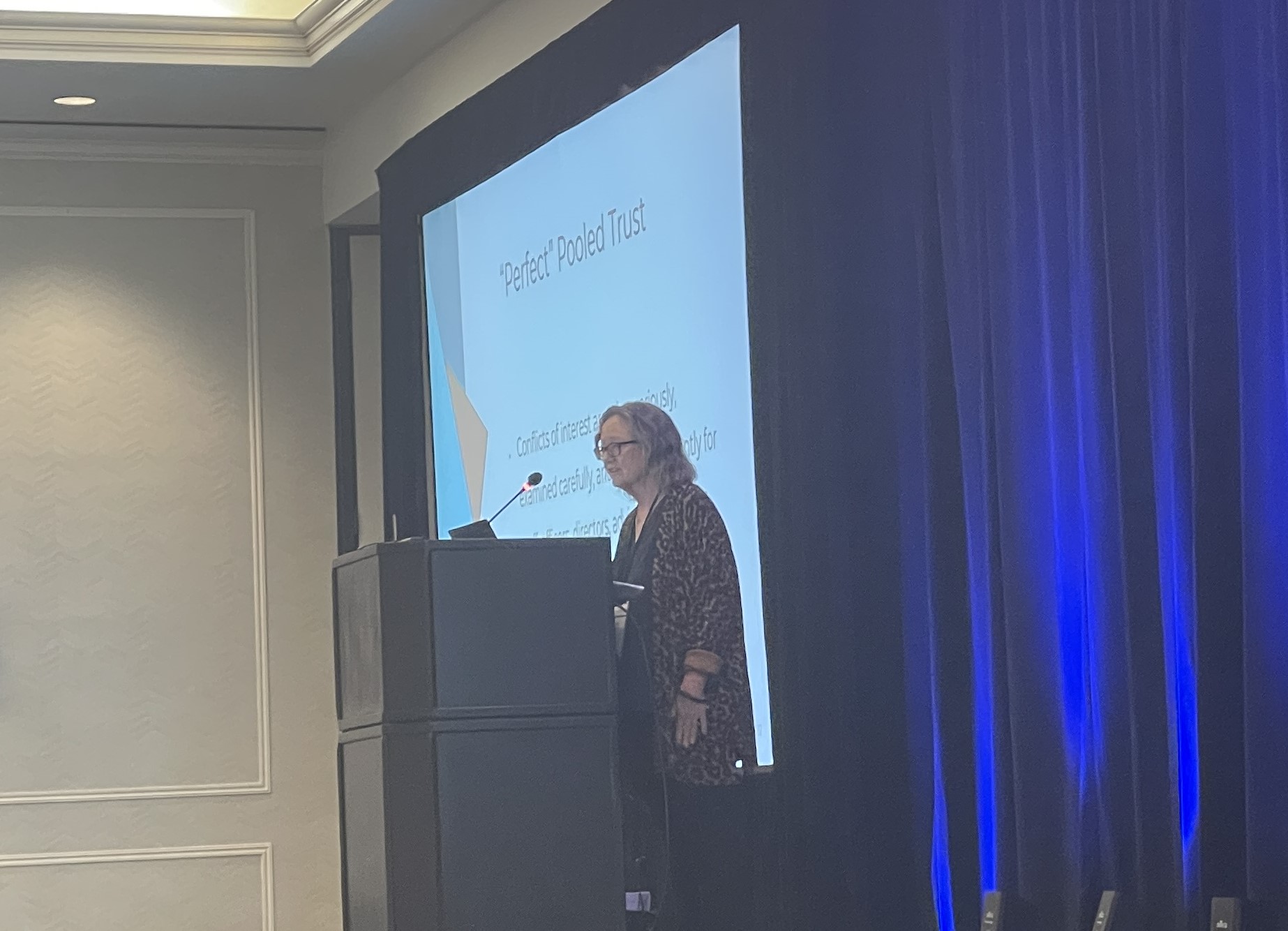
Renée C. Lovelace of The Lovelace Law Firm, P.C. has been a certified elder law attorney since 1997 as well as a caregiver for a family member with special needs for more than 30 years. At April’s 2024 Academy of Special Needs Planners Conference, she spoke to attendees about the tipping point facing pooled special needs trusts today – and specifically about how attorneys might approach comparing and evaluating these types of trusts.
“One of the objectives of this presentation,” Lovelace told session participants, “is to really promote understanding. We really do need to protect pooled trusts.”
“There are remarkable pooled trusts out there, offering irreplaceable benefits,” she said. “But there have been recent catastrophes that are truly heartbreaking that could bring an end to many pooled trusts and could drastically change the statues we’re dealing with.”
One of these recent scandals involved a class action lawsuit against a special needs trust fund company in Florida. The nonprofit, the Center for Special Needs Trust Administration, is accused of misappropriating tens of millions of dollars from clients with disabilities; more than $100 million in special needs trust assets have gone missing from their accounts.
Why We Need Pooled Trusts
First authorized by the Omnibus Budget Reconciliation Act of 1993, pooled trusts are not only essential, Lovelace said, but also “absolutely the best concept that has ever come along in the disability world for planning.”
They can “literally save lives, save money, enhance quality of life, serve as a launching pad, a safety net, and a springboard,” she added. “We know that people who have extensive care and medical needs generally need special needs trusts. Special needs trusts need trustees. But there isn’t always an experienced corporate trustee or individual trustee available. Sometimes pooled trusts are the only answers. Sometimes they’re not the only answer, but clearly the best answer because of what they can do.”
A major issue right now, she pointed out, is that the pooled trust industry needs to put better regulations in place. “It’s been 30 years,” she said. “Why don’t we have more standards?”
Ultimately, what she wants to see is an audit process developed for pooled trusts as well as consensus on what constitutes best practices in the industry.
Being able to compare pooled trusts is a necessary piece of this puzzle. She acknowledges that not everyone can be an expert in this area. In fact, even those who are experts “can’t predict the future and … can’t independently verify every claim or document.” However, there are steps attorneys can take to gather information when evaluating different pooled trusts.
Bananas vs. Pooled Trusts?
It’s unlikely the “perfect” pooled trust exists, Lovelace said. But in her presentation, she gave a glimpse into what kinds of characteristics might indicate a particularly well-run pooled trust. These include the following:
The pooled trust clearly explains the services it will provide – and provides those services.
The trust does not look to fees or remainder retention as a fundraising system for the organization.
Its officers and directors understand the complexities of running a business and are committed to long-term sustainability.
Contact information is readily available.
The trust focuses on expenses line by line to ensure all dollars spent are allocated, necessary, and reasonable.
The trust has policies and procedures in place that address all facets of operations.
It issues conflicts of interest disclosures and easy-to-understand financial accountings at least annually.
It includes a strong charitable component.
The trust offers tremendous service to its clients.
“We want advisors that constantly monitor laws, regulations, rules, and policies in the best interest of their beneficiaries,” Lovelace said.
She also offered an unexpected analogy regarding the evaluation of pooled trusts: “When you go to the store to buy a banana, do you care what they’re paying the board of directors? Do you care what the president makes? Do you care about their policies and procedures?” she asked the audience.
“We don’t care,” she went on. “We’re just looking at the price of the banana and whether or not it’s a good banana.
“But with pooled trusts, there’s going to have to be a level of transparency that’s far beyond what other organizations or other types of business need to provide. A lot of their internal operations information is going to need to be there on their websites in order for us outsiders … to be able to point these things and say [to clients], ‘This is why you should be comfortable with this pooled trust.’”
Pros and Cons of Pooled Trusts
Lovelace cautions that many clients may resist the idea of pooled trusts until they have a better understanding of their potential risks and upsides.
Whereas pooled trusts can offer public benefits expertise, supportive programs, an improved quality of life, and much more, they also require the client to give up control to some extent. This can mean a level of uncertainty regarding how funds will be administered and the risk of fraud or, simply, disappointment.
And with more pooled trust options on the market than ever, evaluating them all is becoming much more challenging. They can be vastly different, and an attorney needs to be knowledgeable about everything from special needs trusts to employment laws to federal and state tax law to be able to identify the best options.
“We’re trying to evaluate from the outside, not seeing everything that’s going on on the inside,” she said. “The analysis isn’t perfect, but don’t give up. Some people who need trusts will have no other options, and well-run pooled trusts offer life-changing benefits.”
As a starting point for comparing programs, Lovelace pointed session attendees to CPT Institute’s numerically based evaluation tool for pooled trusts.
She also referenced pooled trust websites that currently provide comprehensive information, naming the Arc of Texas Master Pooled Trust and its toolkit as the gold standard.
Ultimately, Lovelace believes there is a need to establish an “audit that will actually go all the way down to the component parts and certify that things exist if you can’t get to everything.
“You can’t foil all burglars,” she added, “but at least lock the doors.”
Latest Articles
Nursing Home Arbitration Agreement Held Unenforceable
The Court of Appeals of Arkansas found that an arbitration agreement that did not include the name of the nursing home resident was unenforceable because it did not identify the contractual parties. The court rejected the nursing home's argument that...
The First Circuit Court of Appeals found that a postal service employee had validly designated his former wife and their children as beneficiaries of his life insurance policy because the designation form was in writing, signed, witnessed, and received by...
Subscribe to the Knowledge Bank.
Get new article and cases summaries
You have been successfully subscribed to the knowledge bank.
Evaluating Pooled Special Needs Trusts: 2024 ASNP Conference
Renée C. Lovelace of The Lovelace Law Firm, P.C. has been a certified elder law attorney since 1997 as well as a caregiver for a family member with special needs for more than 30 years. At April’s 2024 Academy of Special Needs Planners Conference, she spoke to attendees about the tipping point facing pooled special needs trusts today – and specifically about how attorneys might approach comparing and evaluating these types of trusts.
“One of the objectives of this presentation,” Lovelace told session participants, “is to really promote understanding. We really do need to protect pooled trusts.”
“There are remarkable pooled trusts out there, offering irreplaceable benefits,” she said. “But there have been recent catastrophes that are truly heartbreaking that could bring an end to many pooled trusts and could drastically change the statues we’re dealing with.”
One of these recent scandals involved a class action lawsuit against a special needs trust fund company in Florida. The nonprofit, the Center for Special Needs Trust Administration, is accused of misappropriating tens of millions of dollars from clients with disabilities; more than $100 million in special needs trust assets have gone missing from their accounts.
Why We Need Pooled Trusts
First authorized by the Omnibus Budget Reconciliation Act of 1993, pooled trusts are not only essential, Lovelace said, but also “absolutely the best concept that has ever come along in the disability world for planning.”
They can “literally save lives, save money, enhance quality of life, serve as a launching pad, a safety net, and a springboard,” she added. “We know that people who have extensive care and medical needs generally need special needs trusts. Special needs trusts need trustees. But there isn’t always an experienced corporate trustee or individual trustee available. Sometimes pooled trusts are the only answers. Sometimes they’re not the only answer, but clearly the best answer because of what they can do.”
A major issue right now, she pointed out, is that the pooled trust industry needs to put better regulations in place. “It’s been 30 years,” she said. “Why don’t we have more standards?”
Ultimately, what she wants to see is an audit process developed for pooled trusts as well as consensus on what constitutes best practices in the industry.
Being able to compare pooled trusts is a necessary piece of this puzzle. She acknowledges that not everyone can be an expert in this area. In fact, even those who are experts “can’t predict the future and … can’t independently verify every claim or document.” However, there are steps attorneys can take to gather information when evaluating different pooled trusts.
Bananas vs. Pooled Trusts?
It’s unlikely the “perfect” pooled trust exists, Lovelace said. But in her presentation, she gave a glimpse into what kinds of characteristics might indicate a particularly well-run pooled trust. These include the following:
The pooled trust clearly explains the services it will provide – and provides those services.
The trust does not look to fees or remainder retention as a fundraising system for the organization.
Its officers and directors understand the complexities of running a business and are committed to long-term sustainability.
Contact information is readily available.
The trust focuses on expenses line by line to ensure all dollars spent are allocated, necessary, and reasonable.
The trust has policies and procedures in place that address all facets of operations.
It issues conflicts of interest disclosures and easy-to-understand financial accountings at least annually.
It includes a strong charitable component.
The trust offers tremendous service to its clients.
“We want advisors that constantly monitor laws, regulations, rules, and policies in the best interest of their beneficiaries,” Lovelace said.
She also offered an unexpected analogy regarding the evaluation of pooled trusts: “When you go to the store to buy a banana, do you care what they’re paying the board of directors? Do you care what the president makes? Do you care about their policies and procedures?” she asked the audience.
“We don’t care,” she went on. “We’re just looking at the price of the banana and whether or not it’s a good banana.
“But with pooled trusts, there’s going to have to be a level of transparency that’s far beyond what other organizations or other types of business need to provide. A lot of their internal operations information is going to need to be there on their websites in order for us outsiders … to be able to point these things and say [to clients], ‘This is why you should be comfortable with this pooled trust.’”
Pros and Cons of Pooled Trusts
Lovelace cautions that many clients may resist the idea of pooled trusts until they have a better understanding of their potential risks and upsides.
Whereas pooled trusts can offer public benefits expertise, supportive programs, an improved quality of life, and much more, they also require the client to give up control to some extent. This can mean a level of uncertainty regarding how funds will be administered and the risk of fraud or, simply, disappointment.
And with more pooled trust options on the market than ever, evaluating them all is becoming much more challenging. They can be vastly different, and an attorney needs to be knowledgeable about everything from special needs trusts to employment laws to federal and state tax law to be able to identify the best options.
“We’re trying to evaluate from the outside, not seeing everything that’s going on on the inside,” she said. “The analysis isn’t perfect, but don’t give up. Some people who need trusts will have no other options, and well-run pooled trusts offer life-changing benefits.”
As a starting point for comparing programs, Lovelace pointed session attendees to CPT Institute’s numerically based evaluation tool for pooled trusts.
She also referenced pooled trust websites that currently provide comprehensive information, naming the Arc of Texas Master Pooled Trust and its toolkit as the gold standard.
Ultimately, Lovelace believes there is a need to establish an “audit that will actually go all the way down to the component parts and certify that things exist if you can’t get to everything.
“You can’t foil all burglars,” she added, “but at least lock the doors.”
Evaluating Pooled Special Needs Trusts: 2024 ASNP Conference
<p><img alt="Renee Lovelace presents on pooled trusts at the 2024 Academy of Special Needs Planners Conference." src="https://cdn.elderlawanswers.com/common/uploads/photos/20526-Renee Lovelace presents at ASNP National Conference 2024 IMG_7418.JPG" style="float:right; height:200px; margin-left:10px; margin-right:10px; width:277px" /><span style="font-size:14.0pt">Renée C. Lovelace of The Lovelace Law Firm, P.C. has been a certified elder law attorney since 1997 as well as a caregiver for a family member with special needs for more than 30 years. At April’s <a href="https://wealthcounsel.swoogo.com/asnp2024" target="_self">2024 Academy of Special Needs Planners Conference</a>, she spoke to attendees about the tipping point facing pooled special needs trusts today – and specifically about how attorneys might approach comparing and evaluating these types of trusts.</span></p>
<p><span style="font-size:14.0pt">“One of the objectives of this presentation,” Lovelace told session participants, “is to really promote understanding. We really do need to protect pooled trusts.”</span></p>
<p><span style="font-size:14.0pt">“There are remarkable pooled trusts out there, offering irreplaceable benefits,” she said. “But there have been recent catastrophes that are truly heartbreaking that could bring an end to many pooled trusts and could drastically change the statues we’re dealing with.”</span></p>
<p><span style="font-size:14.0pt">One of these recent scandals involved a <a href="https://www.classaction.org/media/chamberlin-et-al-v-boston-finance-group-llc-et-al.pdf" target="_self">class action lawsuit</a> against a special needs trust fund company in Florida. The nonprofit, the Center for Special Needs Trust Administration, is accused of misappropriating tens of millions of dollars from clients with disabilities; more than <a href="https://attorney.elderlawanswers.com/corporate-trustee-accused-of-misappropriating-100m-in-snts-20332" target="_self">$100 million in special needs trust assets</a> have gone missing from their accounts.</span></p>
<h2><strong><span style="font-size:14.0pt">Why We Need Pooled Trusts</span></strong></h2>
<p><span style="font-size:14.0pt">First authorized by the Omnibus Budget Reconciliation Act of 1993, pooled trusts are not only essential, Lovelace said, but also “absolutely the best concept that has ever come along in the disability world for planning.”</span></p>
<p><span style="font-size:14.0pt">They can “literally save lives, save money, enhance quality of life, serve as a launching pad, a safety net, and a springboard,” she added. “We know that people who have extensive care and medical needs generally need special needs trusts. Special needs trusts need trustees. But there isn’t always an experienced corporate trustee or individual trustee available. Sometimes pooled trusts are the only answers. Sometimes they’re not the only answer, but clearly the best answer because of what they can do.”</span></p>
<p><span style="font-size:14.0pt">A major issue right now, she pointed out, is that the pooled trust industry needs to put better regulations in place. “It’s been 30 years,” she said. “Why don’t we have more standards?” </span></p>
<p><span style="font-size:14.0pt">Ultimately, what she wants to see is an audit process developed for pooled trusts as well as consensus on what constitutes best practices in the industry.</span></p>
<p><span style="font-size:14.0pt">Being able to compare pooled trusts is a necessary piece of this puzzle. She acknowledges that not everyone can be an expert in this area. In fact, even those who are experts “can’t predict the future and … can’t independently verify every claim or document.” However, there are steps attorneys can take to gather information when evaluating different pooled trusts.</span></p>
<h2><strong><span style="font-size:14.0pt">Bananas vs. Pooled Trusts?</span></strong></h2>
<p><span style="font-size:14.0pt">It’s unlikely the “perfect” pooled trust exists, Lovelace said. But in her presentation, she gave a glimpse into what kinds of characteristics might indicate a particularly well-run pooled trust. These include the following:</span></p>
<ul>
<li><span style="font-size:14.0pt">The pooled trust clearly explains the services it will provide – and provides those services.</span></li>
<li><span style="font-size:14.0pt">The trust does not look to fees or remainder retention as a fundraising system for the organization.</span></li>
<li><span style="font-size:14.0pt">Its officers and directors understand the complexities of running a business and are committed to long-term sustainability.</span></li>
<li><span style="font-size:14.0pt">Contact information is readily available.</span></li>
<li><span style="font-size:14.0pt">The trust focuses on expenses line by line to ensure all dollars spent are allocated, necessary, and reasonable.</span></li>
<li><span style="font-size:14.0pt">The trust has policies and procedures in place that address all facets of operations.</span></li>
<li><span style="font-size:14.0pt">It issues conflicts of interest disclosures and easy-to-understand financial accountings at least annually.</span></li>
<li><span style="font-size:14.0pt">It includes a strong charitable component.</span></li>
<li><span style="font-size:14.0pt">The trust offers tremendous service to its clients.</span></li>
</ul>
<p><span style="font-size:14.0pt">“We want advisors that constantly monitor laws, regulations, rules, and policies in the best interest of their beneficiaries,” Lovelace said.</span></p>
<p><span style="font-size:14.0pt">She also offered an unexpected analogy regarding the evaluation of pooled trusts: “When you go to the store to buy a banana, do you care what they’re paying the board of directors? Do you care what the president makes? Do you care about their policies and procedures?” she asked the audience. </span></p>
<p><span style="font-size:14.0pt">“We don’t care,” she went on. “We’re just looking at the price of the banana and whether or not it’s a good banana. </span></p>
<p><span style="font-size:14.0pt">“But with pooled trusts, there’s going to have to be a level of transparency that’s far beyond what other organizations or other types of business need to provide. A lot of their internal operations information is going to need to be there on their websites in order for us outsiders … to be able to point these things and say [to clients], ‘This is why you should be comfortable with this pooled trust.’”</span></p>
<h2><strong><span style="font-size:14.0pt">Pros and Cons of Pooled Trusts</span></strong></h2>
<p><span style="font-size:14.0pt">Lovelace cautions that many clients may resist the idea of pooled trusts until they have a better understanding of their potential risks and upsides.</span></p>
<p><span style="font-size:14.0pt">Whereas pooled trusts can offer public benefits expertise, supportive programs, an improved quality of life, and much more, they also require the client to give up control to some extent. This can mean a level of uncertainty regarding how funds will be administered and the risk of fraud or, simply, disappointment. </span></p>
<p><span style="font-size:14.0pt">And with more pooled trust options on the market than ever, evaluating them all is becoming much more challenging. They can be vastly different, and an attorney needs to be knowledgeable about everything from special needs trusts to employment laws to federal and state tax law to be able to identify the best options.</span></p>
<p><span style="font-size:14.0pt">“We’re trying to evaluate from the outside, not seeing everything that’s going on on the inside,” she said. “The analysis isn’t perfect, but don’t give up. Some people who need trusts will have no other options, and well-run pooled trusts offer life-changing benefits.”</span></p>
<p><span style="font-size:14.0pt">As a starting point for comparing programs, Lovelace pointed session attendees to CPT Institute’s numerically based <a href="https://www.cptinstitute.org/wp-content/uploads/2022/12/CPT-PSNT-Evaluation-Tool-QR-8.19.21.pdf" target="_self">evaluation tool for pooled trusts</a>. </span></p>
<h2><strong><span style="font-size:14.0pt">Recommendations</span></strong></h2>
<p><span style="font-size:14.0pt">For the special needs planning attorneys in attendance, Lovelace recommended numerous resources – from the book <a href="https://www.amazon.com/Third-Party-Self-Created-Trusts-Clifton-Kruse/dp/1590310373" target="_self">Third-Party and Self-Created Trusts</a> by Clifton Kruse to Stetson University’s <a href="https://www.stetson.edu/law/academics/elder/home/media/Best_Practices_Guidelines_Final_42022.pdf" target="_self">Life Passages PSNT Best Practices Guidelines</a>.</span></p>
<p><span style="font-size:14.0pt">She also referenced pooled trust websites that currently provide comprehensive information, naming the <a href="https://www.thearcoftexas.org/mpt/" target="_self">Arc of Texas Master Pooled Trust</a> and its <a href="https://www.thearcoftexas.org/wp-content/uploads/MPT-TOOLKIT-2022-UPDATE.pdf" target="_self">toolkit</a> as the gold standard.</span></p>
<p><span style="font-size:14.0pt"><span style="color:black">Ultimately, Lovelace believes there is a need to establish an “audit that will actually go all the way down to the component parts and certify that things exist if you can’t get to everything.</span></span></p>
<p><span style="font-size:14.0pt"><span style="color:black">“You can’t foil all burglars,” she added, “but at least lock the doors.”</span></span></p>
End User License Agreement (EULA)
Internet Listing Agreement
This Internet Listing Agreement (the "Agreement") is made by and between WealthCounsel, LLC,
with offices
located at 3 2nd Street, Ste. #501, Jersey City, New Jersey, USA, 07302, a Nevada limited
liability company
(the "Company") and the subscribing law firm (the "Firm"). The term "Firm" includes each
individual attorney
listed on the Firm's Web Page (as defined below) on the Company's Website (as defined below).
Listing
The Company agrees to insert Information (as defined below) about the Firm in the Company's
Website located
at http://www.elderlawanswers.com or www.specialneedsanswers.com or both (the "Website"),
provided that the
Company reserves the right not to list any and all Information that it deems, in its sole
discretion,
inappropriate, offensive or detrimental to the operation of the Company's business. Listing the
Information
on the Website neither includes submission of the Website or Web Page to Internet search engines
nor
guarantees that the Web Page will be included or ranked in a particular order in the search
results of any
or all Internet search engines.
"Information" in this Agreement means all information provided by or on behalf of the Firm to
the Company in
electronic format only.
"Web Page" in this Agreement means the Information, together with any accompanying graphic or
design
elements, as inserted in the Company's Website. The Company is not responsible for any errors or
omissions
in the Web Page. The Company is not responsible for any errors or omissions in the Template. It
is the
exclusive obligation of the Firm to ensure that the Web Page is free of errors and omissions.
Content License
The Company hereby grants to the Firm permission for the limited use of republishing, in print
or electronic
format, all articles or text ("the Content") authored by the Company specifically for the
product(s) to
which the Firm subscribes (for purposes of clarity, this refers to either ElderLawAnswers or
Academy of
Special Needs Planners), provided that (a) the Firm's subscription with the Company has not
expired or been
deactivated for non-payment, or breach of agreement as stated herein and (b) the Firm does not
re-sell the
Content or (c) use the Content for any other purpose than to promote the Firm; (d) the Firm does
not use the
Content to promote any ancillary business to the firm. The Company retains all copyrights and
ownership of
the Content entitled by law, implied or otherwise and reserves the right to terminate this
Content License
as stated herein, at any time.
Term
The Information will be listed for a period of one (1) year ("Term", which shall include each
renewal term)
beginning on the date of registration by the Firm. On each one (1) year anniversary of this date
(each a
"Renewal Date"), this Agreement will be automatically renewed for an additional twelve (12)
months, unless
either party gives thirty (30) days’ written notice to the other prior to the expiration of the
then current
Term stating that the notifying party wants to terminate this Agreement. Written notice may be
by email to
support@elderlawanswers.com.
Payment and Cancellation
The Firm agrees to give the Company permission to charge the Firm's credit card the annual
subscription fee
in equal installments over 12 consecutive months until the balance of the subscription fee is
paid in full
unless the Firm cancels subscription within 30 days of the initial date of registration by
electronic or
paper submission. The Firm understands that subsequent subscription renewal is automatic unless
the Firm
requests cancellation within the first 30 days after the renewal date (anniversary of
subscription).
Representations and Warranties
The Firm represents and warrants that:
1. The Firm listed on the Web Page (a) has at least three (3) years of experience practicing
elder law as a
principal area of practice, or (b) can demonstrate an equivalent of experience in elder law by
way of
on-going education, training or other practical experience deemed acceptable to the Company;
2. The Firm is entitled to post the legal services described in the Information on the Web
Page;
3. Each attorney listed on the Web Page is duly licensed and qualified to practice law in the
state in which
he or she is listed;
4. Each attorney listed on the Web Page is in good standing in all states in which such attorney
is licensed
and qualified to practice law;
5. Each attorney listed on the Web Page is covered by malpractice insurance for performing the
legal services
described on the Web Page under the name of such attorney, with limits of at least $100,000 per
claim and
$300,000 in the aggregate, issued by a nationally recognized and reputable insurance
company;
6. The Information (a) does not infringe or violate the rights, including intellectual property
rights and
any right of privacy or publicity, of any third party, (b) is neither defamatory nor obscene,
and (c) is
true and correct in all respects;
7. This Agreement is a legal and valid obligation binding on the Firm and enforceable on its
terms, the
execution, delivery and performance of which does not conflict with any other agreement,
instrument or
understanding, oral or written, to which the Firm is a party or by which it is bound, nor
violate any law,
rule or regulation applicable to the Firm; and
8. The person executing this Agreement on behalf of the Firm is a partner or owner of the Firm,
duly
authorized to execute this Agreement on behalf of the Firm.
Subscribers of the Academy of Special Needs Planners (ASNP) who are not law firms further
warrant:
1. That each financial planner listed on the Web Page is a qualified as a CFP, CLU, ChFC or
Chartered Special
Needs Consultant; and
2. That every trust administrator listed on the Web Page has been recommended by an ASNP
subscriber who is
not also a member of that trust administrator’s company.
Covenants
The Firm undertakes covenants and agrees to take each of the following actions, and if the Firm
is not an
individual, to ensure that each attorney listed on the Web Page takes such action:
1. to comply with all laws, rules and regulations applicable to it, him or her in each state and
jurisdiction
in which he or she is licensed and qualified to practice law;
2. to use the Website and the Web Page in compliance with U.S. law and any other applicable laws,
rules and
regulations;
3. not to use the Website or the Web Page for any illegal purposes;
4. not to interfere with the Website, the Company's other subscribers and their web pages on the
Website, and
any other services the Company may provide, directly or indirectly, to the public or its
subscribers;
and
5. to keep the Information current and updated on at least a monthly basis during the term of
this Agreement,
and to correct any errors and omissions therein within twenty-four (24) hours of becoming aware
or being
notified of them.
Terms and Conditions
In addition to any other rights and remedies at law or in equity, the Company reserves the right
to
terminate this Agreement and remove the Web Page without prior notice (a) if payment of the
Listing Fee is
Past Due; (b) if the Firm breaches any term or condition of this Agreement, provided, the
Company shall use
commercially reasonable efforts to notify the Firm of such removal and termination and in the
case of a
breach under clause (b), the Firm shall have fifteen (15) days from the date of such notice to
cure the
breach; and (c) if the Company determines based on feedback from consumers that the Firm or any
of its
listed attorneys does not meet the standard of practice desired of subscribers of the Website.
"Past Due"
means the annual Listing Fee (paid once a year or in 12 equal installments, once a month) is not
received by
the Company on or before the 30th day from which the payment is due. If a breach is cured to the
satisfaction of the Company, in its sole discretion, the Company shall re list the Web Page and
restore any
suspended service in accordance with the terms of this Agreement. In case of a permanent removal
of the Web
Page and cancellation of this Agreement, the Company shall reimburse the Firm for any Listing
Fees
theretofore paid for the remainder of the current Term on a prorated basis. Other than as stated
in the
immediately preceding sentence, the Company does not give any refunds.
Provision of Services
The Company intends, but does not guarantee, that the Web Page will be operational 24 hours per
day, 7 days
per week, 365 days per year. The Website and Web Page may not be hosted on the Company's own
servers, and
the Company depends on a hosting service provider to keep the Website and Web Page operational.
Notwithstanding anything to the contrary in this Agreement, the Company's obligation to keep the
Website and
Web Page operational is subject to the delivery and limited by the scope of hosting services
provided to the
Company by its hosting service. Interruptions in service demonstrably due to a failure of the
Company's or
its hosting service provider's web servers ("Interruptions") that last twenty-four (24)
continuous hours or
less will not be compensated. Interruptions that last more than twenty-four (24) continuous
hours will
result in an extension of the Term of this Agreement equal to the duration of the Interruption
(the
"Extension of Service") not to exceed 30 (thirty) days. AN EXTENSION OF SERVICE IS THE FIRM'S
SOLE REMEDY
FOR AN INTERRUPTION IN SERVICE, AT LAW AND IN EQUITY.
User Information
Any and all information provided by or collected from visitors of the Website and the Web Page
(the "User
Information") shall be owned solely by the Company, except that the User Information which is
part of the
text of an e-mail communication initiated on the Website or the Web Page, shall be treated as
confidential
and as protected by the attorney-client privilege between the user who initiated the e-mail and
the Firm or
attorney to whom it is addressed (the "Confidential Information"). User Information that would
otherwise be
deemed to be Confidential Information shall not qualify as Confidential Information if it is
also provided
to or collected by the Company in a manner other than as indicated above. The Company will
neither collect,
track nor store Confidential Information.
No Warranties
THE COMPANY DOES NOT MAKE ANY REPRESENTATIONS OR WARRANTIES, AND HEREBY EXPRESSLY DISCLAIMS ALL
WARRANTIES
OF ANY KIND AS TO ANY ASPECT OF THE WEBSITE, THE WEB PAGE, THE INFORMATION THEREIN AND ANY
SERVICES PROVIDED
UNDER THIS AGREEMENT, INCLUDING THE WARRANTIES OF MERCHANTABILITY, FITNESS FOR A PARTICULAR
PURPOSE AND
NON-INFRINGEMENT. THE COMPANY DOES NOT WARRANT THAT THE WEBSITE AND THE WEB PAGE WILL BE ONLINE
UNINTERRUPTED, ERROR FREE OR COMPLETELY SECURE, AND WILL NOT BE LIABLE FOR THE CONSEQUENCES OF
ANY
INTERRUPTIONS, ERRORS OR BREACHES IN SECURITY. IN ADDITION, THE COMPANY SPECIFICALLY DISCLAIMS
ANY
REPRESENTATIONS AND WARRANTIES WITH RESPECT TO ANY SERVICES OR PRODUCTS OFFERED OR SOLD THROUGH
THE WEBSITE.
Limitation Of Liability
IN NO EVENT WILL THE COMPANY BE LIABLE TO THE FIRM FOR LOSS OF PROFITS, LOSS OF REVENUES, LOSS
OF SAVINGS,
LOSS OF USE, LOSS OR CORRUPTION OF CONTENT, DATA OR INFORMATION OR ANY INDIRECT, INCIDENTAL,
SPECIAL,
EXEMPLARY, PUNITIVE OR CONSEQUENTIAL DAMAGES, WHETHER UNDER TORT, CONTRACT OR OTHER THEORIES OF
RECOVERY. IN
NO EVENT WILL THE COMPANY'S TOTAL LIABILITY ARISING OUT OF, CONNECTED WITH OR RESULTING FROM
THIS AGREEMENT
EXCEED THE AMOUNT PAID BY THE FIRM TO THE COMPANY UNDER THIS AGREEMENT FOR THE TWELVE (12) MONTH
PERIOD
IMMEDIATELY PRECEDING THE EVENT GIVING RISE TO THE CLAIM OF LIABILITY.
Indemnification
Each party will indemnify, defend and hold the other party harmless from and against any and all
costs,
liabilities, losses, damages and expenses, including reasonable attorney's fees, and amounts
paid in
settlement, resulting from or arising out of any claim, suit, action or proceeding brought
against the other
party as a consequence of the indemnifying party's infringement of any intellectual property
right of a
third party, including without limitation, any third party patent, copyright, trademark or trade
secret.
This indemnification is subject to the parties' limitation of liability under this Agreement.
Governing Law
This Agreement shall be governed by and construed in accordance with the laws of the State of
New Jersey and
shall be deemed to have been executed in Jersey City, New Jersey. Any legal action arising from
or related
to this Agreement shall be brought in any state or federal court located in the State of New
Jersey, County
of Hudson, and the parties hereby consent to the jurisdiction of such courts.
Entire Agreement
This Agreement is the entire Agreement between the parties with respect to the subject matter
hereof.
Arbitration
Any disputes that arise between the parties with respect to the performance of this Agreement
shall be
submitted to binding arbitration in the State of New Jersey, County of Hudson by the American
Arbitration
Association, to be determined and resolved by said Association under its rules and procedures in
effect at
the time of submission and the judgment upon the award be entered in any court having
jurisdiction thereof.
The parties hereby agree to share equally in the costs of said arbitration except that in the
discretion of
the arbitrator, any award may include the cost of the party's counsel if the arbitrator
expressly determines
that the party against whom the award is entered has caused the dispute, controversy or claim to
be
submitted to arbitration as a frivolous or dilatory action.
Severability
Should any term, warrant, covenant, condition, or provision of this Agreement be held to be
invalid or
unenforceable, the balance of this Agreement shall remain in full force and shall stand as if
the
unenforceable part did not exist.
Validity
This Agreement is valid and enforceable against the Firm. Payment by the Firm to the Company, by
check or
electronic transaction, constitutes the Firm's execution and delivery of this Agreement.

 Renée C. Lovelace of The Lovelace Law Firm, P.C. has been a certified elder law attorney since 1997 as well as a caregiver for a family member with special needs for more than 30 years. At April’s 2024 Academy of Special Needs Planners Conference, she spoke to attendees about the tipping point facing pooled special needs trusts today – and specifically about how attorneys might approach comparing and evaluating these types of trusts.
 Subscribe to the Knowledge Bank.
